
How do you plan a Morocco trip from Dubai with your family?
A Morocco trip from Dubai for families: visa-free entry for Gulf citizens, the e-visa for UAE residents, flight times, a 6-day plan and costs in AED.
- 📍 Destination
- Casablanca, Marrakech and the Atlas Mountains, Morocco
- ☀️ Best time
- Spring (March to May) and autumn (late September to November) are the most comfortable seasons for Marrakech. July and August are very hot inland, so Morocco is not a good escape from the Gulf summer
- 💰 Budget
- Our planning range: about AED 15,500 to 25,500 (about SAR 15,800 to 26,000) for a family of four for 6 days, including flights; UAE and Saudi citizens need no visa
- ✅ Facts checked
- 29 October 2026
A Morocco trip from Dubai gives Gulf families a lot in one week. There is the Hassan II Mosque on the Atlantic in Casablanca, the souks and palaces of Marrakech, and a day in the Atlas Mountains. All of this comes in a Muslim-majority country where halal food and prayer are part of daily life. This guide covers the entry rules for Gulf citizens and for UAE and Saudi residents, flights from Dubai, Abu Dhabi, Jeddah and Riyadh, the travel time, a relaxed 6-day plan and costs in dirhams. It is a researched plan, not a personal trip report.
Exchange basis: AED 1 = about MAD 2.68 and SAR 1 = about MAD 2.63 (29 October 2026, ExchangeRate-API). On the same day, EUR 1 was about AED 4.09.
Morocco trip from Dubai at a glance
| Flight time | 8 h 45 Dubai to Casablanca, 7 h 30 back (Emirates) |
| Distance | About 6,080 km Dubai to Casablanca (great-circle) |
| Visa, UAE, Saudi and other GCC citizens | Not required |
| Visa, UAE residents with other passports | E-visa possible with a UAE residence permit valid 180+ days |
| Visa, Saudi residents with other passports | Depends on nationality; Saudi residence alone does not qualify |
| Currency | Moroccan dirham (MAD) |
| Best family season | March to May and late September to November |
Morocco visa and entry rules from the UAE and Saudi Arabia
Our sources were the Moroccan Ministry of Foreign Affairs exemption list and the official e-visa conditions on Acces Maroc. Check both again before you pay for flights.
UAE, Saudi and other Gulf citizens
The ministry lists the United Arab Emirates, Saudi Arabia, Kuwait, Qatar, Bahrain and Oman among the countries whose citizens do not need a visa for Morocco. The list does not show a stay limit next to the Gulf countries. A stay of up to 90 days is widely reported, but we could not confirm the length on the ministry page.
UAE residents (expat families)
Your passport decides first. The same ministry list also exempts passports from the Philippines, Indonesia, Malaysia, Turkey, Tunisia, the UK, the US and Canada, among others. If your passport needs a visa, the official e-visa has three routes:
- Category A (by nationality): ordinary passports of Azerbaijan, Benin, Brunei, Cambodia, Guatemala, India, Jordan, Laos, Israel, Thailand and Vietnam.
- Category B (by residence): foreigners living in a listed country, which includes the United Arab Emirates. You need a residence permit valid for at least 180 days on the day you apply and a passport valid for at least 90 days. This is the route for most Pakistani, Egyptian, Bangladeshi and Sri Lankan families living in the UAE.
- Category C (by visa): holders of a multiple-entry, non-electronic Schengen, US, UK, Irish, Japanese, Canadian, Australian, Norwegian or New Zealand visa that is valid for at least 90 more days.
Saudi residents
Saudi Arabia is not on the Category B residence list. If you live in Riyadh or Jeddah, you can only use the e-visa through your nationality (Category A) or a qualifying visa (Category C). Otherwise, apply at the Moroccan embassy or consulate.
E-visa rules, fees and timing
The official conditions say:
- the e-visa is single entry, valid for up to 180 days from issue, with a stay of up to 30 days
- processing takes 24 working hours (express) or 72 working hours (standard)
- children under 18 may only enter with a parent or legal representative
- paid applications cannot be cancelled or refunded
- families can group all applications into one file
- at the border, you may be asked for a return ticket, proof of funds (an international bank card or more than 70 euros in cash per person per day, about AED 286) and hospital and repatriation insurance
Khaleej Times reported fees of AED 282.31 (standard) and AED 403.29 (express). Other sites quote MAD 770 and MAD 1,100. We could not see the fee on the official portal, so treat these as reported figures. Our visa checker can help you compare destinations for each passport in your family.
How many hours from Dubai to Morocco? Flights and travel time
From Dubai: Emirates lists 7 flights a week to Casablanca. The sample schedule shows EK751 leaving at 07:25 and arriving at 12:10 local time (8 h 45). The return, EK752, leaves Casablanca at 14:10 and lands in Dubai at 01:40 the next day (7 h 30). That schedule implies Morocco is four hours behind Dubai, but check the time difference for your dates. Royal Air Maroc also restarted Casablanca to Dubai flights on 3 July 2026, three times a week on a Boeing 787-8, according to the Arab Air Carriers’ Organization.
From Abu Dhabi: Etihad flies Abu Dhabi to Casablanca. On 29 October 2026, its page showed return economy fares from AED 2,670 for mid-November dates and from AED 2,490 for January and February 2027. Fares change daily, so treat these as a snapshot. We could not confirm the weekly frequency on Etihad’s site.
From Jeddah and Riyadh: schedule sites list non-stop Saudia flights from Jeddah to Casablanca, and Riyadh options connecting via Jeddah. We could not confirm these on Saudia’s own pages.
Current disruption: on 29 October 2026, Gulf News reported that Dubai International was back at full capacity after the airspace reopened. Etihad had cancelled Abu Dhabi flights to Riyadh and Dammam until 5 November, and Emirates listed Riyadh resuming on 8 November. Check your exact flight with the airline, and check your government’s travel advice, before you book.
How far is Morocco from Dubai?
In a straight line (our great-circle calculation), Dubai to Casablanca is about 6,080 km, Abu Dhabi about 6,050 km, Jeddah about 4,750 km and Riyadh about 5,300 km. That is similar to flying from Dubai to London, so plan an easy first afternoon.
Morocco package from Dubai or plan it yourself?
Searches for a Morocco package, tour package or holiday package from Dubai are common, and a package can make sense for a first visit. You get one price, airport transfers and a driver for the mountain day. Planning it yourself gives you more control over the hotels and the pace. If you compare packages, check:
- which flights are included (non-stop or connecting)
- whether the visa fee is covered for resident family members
- whether hotels have family rooms and lifts (traditional riads often have steep stairs and open courtyards)
- whether the Atlas day trip uses a private car or a shared bus
We did not check package prices, so compare them against the cost table below.
Morocco trip cost from Dubai: a rough guide
These are our planning ranges, not quotes, for a family of four sharing one or two rooms. The only live prices we checked were the Etihad fares above.
| Our planning range (AED) | |
|---|---|
| Return flights, 4 people | AED 9,960 and up (from the AED 2,490 Etihad sample); more in holidays |
| E-visas, 4 residents, if needed | About AED 1,130 at the reported standard fee; none for GCC citizens |
| 5 nights, family hotels or riads | AED 2,500 to 6,000 in total |
| Food, taxis and entry tickets | AED 400 to 800 per day for the family |
| Private car for the Atlas day | AED 500 to 900 |
| Trains Casablanca to Marrakech and back, family | AED 300 to 600 (fares not verified) |
| Total, 6 days | About AED 15,500 to 25,500 (about SAR 15,800 to 26,000) |
Enter your own dates in the trip cost calculator to get a figure for your family.
6-day Morocco itinerary for families
This plan uses the Emirates flight times: you land in Casablanca around midday and fly home in the afternoon. We could not confirm current opening hours or ticket prices for the sights below, so check them locally or on the official sites.
Day 1: Arrive in Casablanca and visit the Hassan II Mosque
Land around midday, check in and rest. In the late afternoon, visit the Hassan II Mosque, built partly over the Atlantic. Muslims can join the prayers there, and non-Muslim family members usually visit on guided tours at set times, so check the schedule for that day. Finish with a walk on the seafront Corniche.
Day 2: Train to Marrakech and Jemaa el-Fnaa at dusk
Take an ONCF train to Marrakech. The journey is often quoted at around three hours, but we could not confirm the current timetable or fares, so check with ONCF before you travel. After check-in, head to Jemaa el-Fnaa square at sunset, when the food stalls open, and see the Koutoubia Mosque minaret, the city’s best-known landmark.
Day 3: Marrakech medina, palaces and souks
Spend a slow morning at the Bahia Palace with its painted ceilings and courtyards. Then walk the souks for spices, lanterns and leather, with a break for mint tea. Rest at the hotel in the afternoon heat, and go back out in the evening.
Day 4: Atlas Mountains day trip
Hire a car with a driver for a day in the Atlas Mountains, for example the Ourika Valley or the villages around Imlil. Children enjoy short walks to waterfalls and a lunch of tagine in a mountain village. Weather and road conditions change, so ask your driver about them the evening before, and pack warm layers outside summer.
Day 5: Jardin Majorelle and back to Casablanca
Visit the Jardin Majorelle early, before the crowds (check the official site for tickets). After lunch, take the train back to Casablanca and stay near the station or the airport.
Day 6: Fly home
Enjoy a slow breakfast, then head to Mohammed V International Airport for the afternoon flight. Leave a generous buffer for check-in and security.
Have more time? Our sister site has an 8-day Morocco itinerary that adds more of the country.
Halal food, prayer and modest dress
The food will feel familiar to Gulf families: tagines, couscous, harira soup, msemen flatbread and grilled meats, with dates and mint tea everywhere. Some hotels and tourist restaurants serve alcohol, so ask if that matters to you. Mosques are easy to find in every medina. Ask your hotel for local prayer times. Modest dress is respectful in the medinas and essential at mosques: shoulders and knees covered, and a headscarf for women visiting mosques.
Money-saving tips
- Compare Abu Dhabi and Dubai departures. The Etihad sample fares changed by about AED 180 per person between November and early 2027.
- Avoid Gulf school holidays if you can, because flights and family rooms cost more.
- Group the e-visa applications into one file for the whole family, and apply early so you can use standard processing rather than express.
- Share one car for the Atlas day rather than booking separate tours.
- Carry some dirhams for taxis and small shops in the medina, and agree on a taxi fare before you set off.
- Check the visa first. Do not book non-refundable flights until every passport in the family has a confirmed entry route.
Looking for other family trips with Islamic heritage? See our Cairo trip from Dubai and Istanbul trip from Dubai guides.
Rules change. Visa exemptions, e-visa conditions and fees, flight schedules and fares can change without notice, and regional flight disruption was ongoing when we wrote this. We last checked everything in this guide on 29 October 2026. Confirm with the Moroccan authorities and your airline before you book.
Frequently asked questions
Do UAE and Saudi citizens need a visa for Morocco?
No. The Moroccan Ministry of Foreign Affairs lists the United Arab Emirates, Saudi Arabia, Kuwait, Qatar, Bahrain and Oman among the countries whose citizens do not need an entry visa. The list does not give a stay length for Gulf passports. The usual visa-free stay is often reported as up to 90 days, but we could not confirm that on the ministry page, so check with the embassy if you plan a long stay.
Can UAE residents get a Morocco e-visa?
Yes, if their passport needs a visa. The official Acces Maroc conditions name the United Arab Emirates among the countries of residence that qualify (Category B). You need an ordinary passport valid for at least 90 days and a residence permit valid for at least 180 days on the day you apply. The e-visa is single entry and allows up to 30 days in Morocco.
Can Saudi residents use the Morocco e-visa?
Not through their Saudi residence alone. Saudi Arabia is not on the official list of countries of residence that qualify. Residents can still use the e-visa if their nationality is on the eligible list (for example India or Jordan) or if they hold a valid multiple-entry Schengen, US, UK or similar visa. Everyone else should apply at the Moroccan embassy or consulate.
How many hours is the flight from Dubai to Morocco?
Emirates gives 8 hours 45 minutes from Dubai to Casablanca and 7 hours 30 minutes for the return. The difference comes from the prevailing winds. Emirates runs 7 flights a week. A connecting flight takes longer.
How far is Morocco from Dubai?
Dubai to Casablanca is about 6,080 km in a straight line (great-circle distance, our calculation). Abu Dhabi to Casablanca is about 6,050 km, Jeddah about 4,750 km and Riyadh about 5,300 km.
Is halal food easy to find in Morocco?
Yes. Morocco is a Muslim-majority country, and its best-known dishes (tagine, couscous, harira soup and grilled meats) are part of everyday food. Some hotels and tourist restaurants serve alcohol, so ask if that matters to your family.
Sources
Rules, fares and prices change. We checked these on 29 October 2026; please confirm on the official page before you book or apply.
- Kingdom of Morocco, Ministry of Foreign Affairs (consulat.ma): list of countries whose citizens are exempted from entry visa into Morocco
- Acces Maroc (official e-visa portal): eVisa general information and conditions of use (categories A, B and C, processing, border documents)
- Khaleej Times: how UAE residents can apply for an e-visa to Morocco (fees in AED, updated 23 Jul 2024)
- Emirates: flights from Dubai (DXB) to Casablanca (CMN), schedule and flight time
- Etihad Airways: flights from Abu Dhabi to Morocco (fares seen on 29 October 2026)
- Arab Air Carriers' Organization: Royal Air Maroc resumes services to Doha and Dubai from July 2026 (17 Jun 2026)
- Gulf News: what UAE residents need to know about travel disruptions (29 Oct 2026)
- ExchangeRate-API open rates (USD base, 29 October 2026)
Photo credits (1)
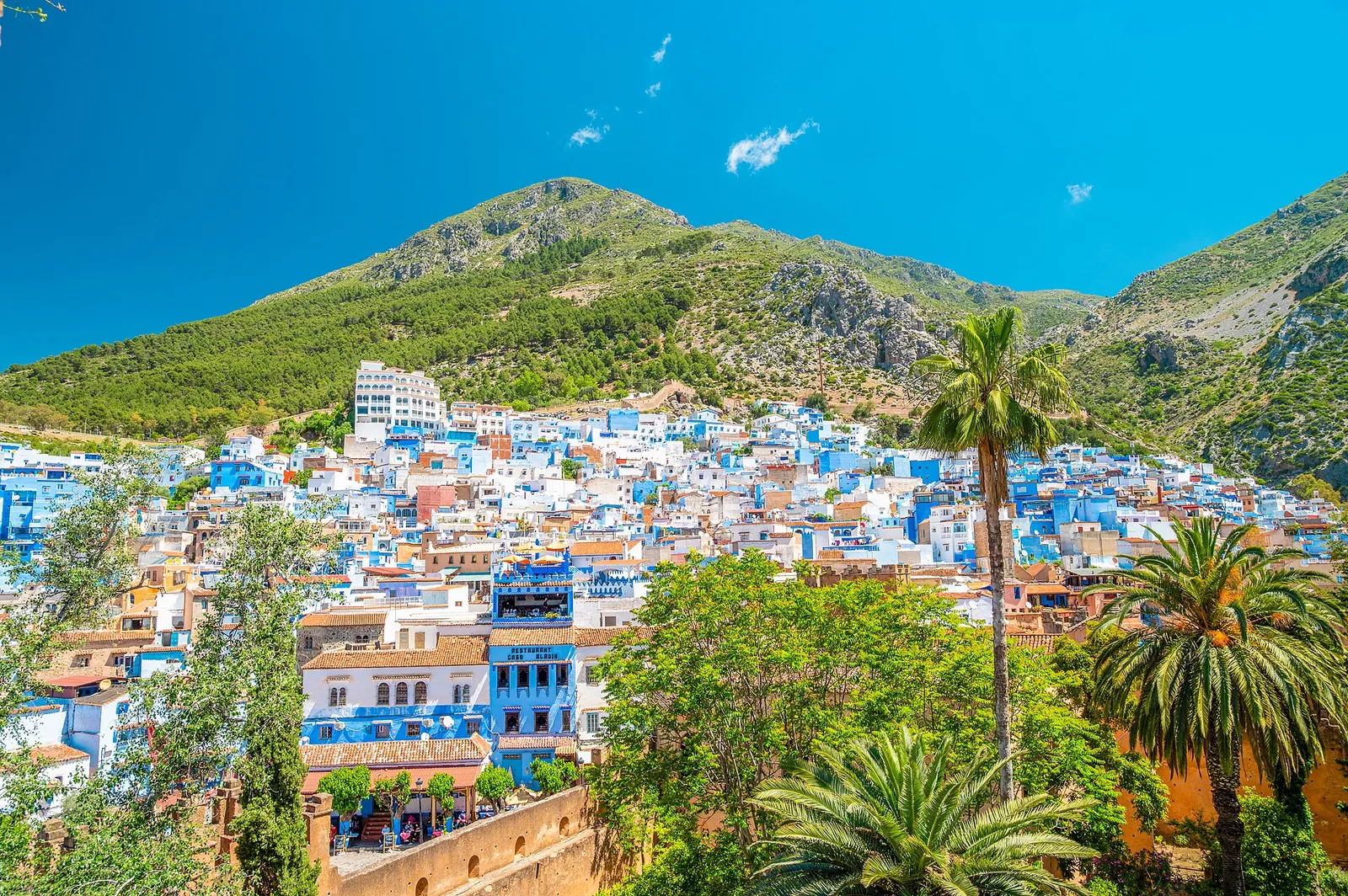
- The blue medina of Chefchaouen with palm trees and the Rif mountains behind: Badr Rachadi, CC BY-SA 4.0, via Wikimedia Commons
This is a researched guide, not a personal trip report. How we research · Affiliate disclosure · اقرأ هذا الدليل بالعربية
More guides for travellers from the Gulf
 7 days
How to plan a Georgia trip from Dubai with your family
A Georgia trip from Dubai for families: visa-free rules for Gulf citizens and UAE residents, 3.5-hour direct flights, halal food and a 7-day mountain plan.
 Visa guide
Can Saudi citizens get a 5-year Schengen visa on their first application?
Schengen visa for Saudi citizens: the 5-year multiple-entry rule, who qualifies, the EUR 90 fee in riyals and what to bring, from the EU rules.
 6 days
Is Trabzon worth visiting with family? A 6-day Trabzon trip plan
A 6-day Trabzon trip plan for Gulf families: visa-free entry for GCC citizens, summer weather, Uzungol lake, Sumela Monastery and the green highlands.